
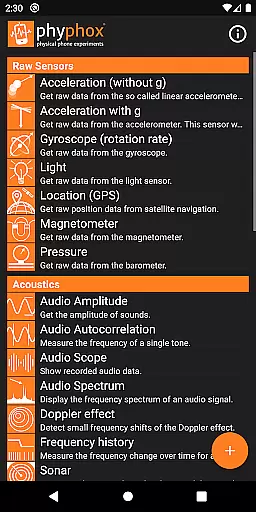
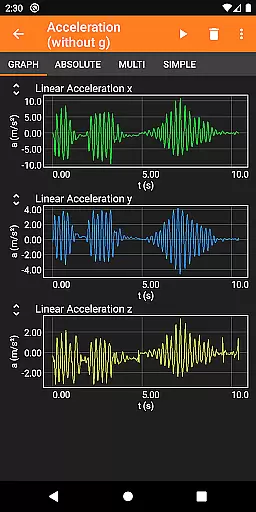
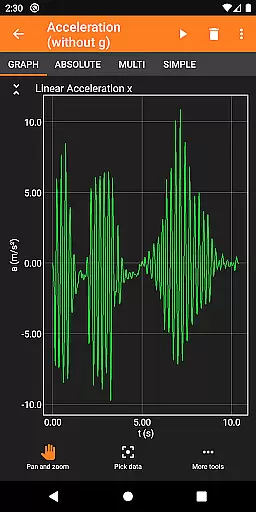
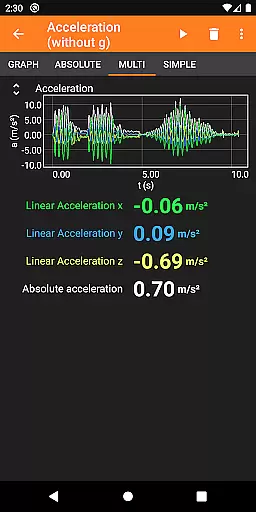
Phyphox is an educational app that transforms your smartphone into a versatile physics laboratory. It provides access to various phone sensors, enabling users to conduct experiments and analyze data directly on their devices. The app supports multiple sensors including accelerometers, magnetometers, gyroscopes, and more, allowing for diverse experimental setups.
The app offers pre-defined experiments that can be launched with a single tap, making it easy for students and educators to get started. Additionally, phyphox allows for the creation of custom experiments through its web-editor, providing flexibility for advanced users. Data collected can be exported in widely-used formats like CSV and Excel, facilitating further analysis and integration with other tools.
One practical application of phyphox is in classroom settings where students can measure gravitational acceleration using their phones as pendulums. This hands-on approach enhances learning by connecting theoretical concepts with real-world measurements, demonstrating the app's value in modern education.
Phyphox stands out with its comprehensive set of features tailored for physics education. The app includes a selection of ready-to-play experiments that cover a wide range of physics topics. These experiments are designed to be intuitive and user-friendly, ensuring that users can focus on learning rather than technical setup.
A key feature is the ability to define custom experiments using the web-editor available at phyphox.org. Users can select sensor inputs, define analysis steps, and create interactive views. The analysis toolbox includes basic operations as well as advanced methods like Fourier transforms and cross-correlation, offering depth for those who need it.
Another notable feature is the remote control functionality, which allows users to manage experiments from any PC on the same network via a web interface. This capability enhances collaboration and makes it easier to conduct complex experiments. Furthermore, support for multiple export formats ensures compatibility with various data analysis tools, extending the app's utility beyond simple data collection.
In the realm of educational applications, content accuracy is paramount. Phyphox exemplifies this by providing access to your smartphone's various sensors for conducting physics experiments with precision. The app allows users to measure physical phenomena directly or through predefined experiments that have been carefully designed to ensure reliable results.
Developed at the 2nd Institute of Physics A at RWTH Aachen University, phyphox carries the hallmark of academic rigor and scientific authority. It supports a wide array of sensors including accelerometers, magnetometers, gyroscopes, and more, which are fundamental in capturing accurate data. This positions the app as an authoritative tool for both learning and teaching physics concepts.
The ability to export data into widely used formats such as CSV and Excel further underscores phyphoxu2019s commitment to facilitating detailed analysis outside the app itself. By enabling students and educators to scrutinize their findings using external software, phyphox promotes a deeper understanding of physics principles grounded in empirical evidence.
Phyphox stands out in the Education category by offering personalized learning paths tailored to individual needs. With its web-editor, users can define their own experiments selecting from a variety of sensor inputs and analysis steps. This customization empowers learners to explore physics concepts at their own pace and according to their specific interests, fostering an engaging educational experience.
The flexibility within phyphox encourages creativity and innovation in learning. Students can create unique interfaces for their experiments, choosing how they interact with the data collected from their device's sensors. Whether it's analyzing sound waves captured by the microphone or studying motion via the accelerometer, each user crafts a distinct journey through physics education.
Moreover, sharing capabilities enhance collaborative learning opportunities. Users can share self-designed experiments with peers or instructors, promoting discussion and feedback loops that refine personal understanding. Through these dynamic interactions facilitated by phyphox, learners forge personalized pathways that adapt dynamically over timeu2014catering not only to current knowledge levels but also evolving with future educational goals.
User-friendly interface
Wide range of sensors
Custom experiment creation
Remote control via web
Data export flexibility
Limited sensor availability
Advanced features require expertise
Internet needed for some functions
Bluetooth connectivity issues
Complex setup for beginners

Learn Words Daily in Just Minutes - Boost Your Language Skills Fast!
 4.60
4.60
Deal Craps (Practice Craps Payouts)
3.80
Explore numbers the Starfall way!
4.00
Quiz App to help case managers studying for CCMC Certification, 200+ Questions
3.40
Master note reading with StaffWars….
4.00
Astronomy Guide To Night Sky
4.30
Discover Your Place in the Universe
4.70
SkyView®, an augmented reality space app, brings stargazing to everyone!
4.40
Memorize anything efficiently with AnkiDroid! Many pre-built decks available.
4.80
Learning the ancient Viking language made simple
4.70
Universe simulator: Find & explore planets system, outer space, astronomy events
4.60
Stack the Countries makes learning world geography fun!
4.50
Learn math, step-by-step
4.30
One of the most engaging and innovative ABC apps on the market.
4.30
Pass your FAA written with flying colors - Study Buddy can help.
4.30
Skelly is a fully poseable, anatomically correct reference skeleton for artists.
4.10
Break Language Barriers with AI—Learn Language Anytime, Anywhere!
4.00
Snap a dog photo to identify its breed instantly. Fast, accurate and easy to use
3.40
Your best partner for learning Japanese words. Based on a best-selling textbook.
2.80


User Reviews